
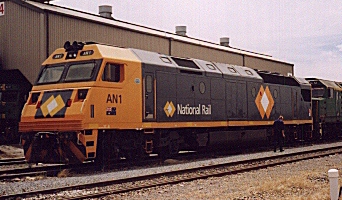
many different locomotives and railcars
Those marked * are not finished at this stage due to my not having some data, particularly tractive effort. It is also hoped to add steam locomotives as appropriate at a later date. The locomotive classes listed are for their original purchasers - lessees - owners. There have been changes, for example AN bought redundant 3rd series T-class hoods from Victoria and called them class CK... Australia Southern bought more than a dozen 422-class double ended flat front cab units from NSW Freightcorp in 2000, partly for use in construction of the Alice Springs to Darwin railway.
Great Northern went shopping with Australia Southern, VicRail and WestRail and bought GMs, T's, Y's and J's - the latter which are almost identical with the Victorian Y's.
A number of the ex-WAGR L-class have found their way east and are also being used by private railways.
West Coast Railways of Victoria bought a number of aging B-class and S-class from VicRail, and they have also restored a steamer which is in revenue service from time to time on their line to Warnambool out of Melbourne.
Pichi-Richi have a range of locomotives native to their operation, but their first loco in service was factually a Western Australian 3ft-6ins gauge W-class steamer. You can use up to 4 locomotives (of the same type) to power your train.
Unfortunately, you cannot mix and match different types (like the GM+CL of late CR/early ANR practice or the S+X of Victoria practice) Most of these locomotive types have already been 'constructed', and more will hopefully be available in the future. The downloads page will carry a thumbnail image of each type with its technical specification. Please email me with the specifications and a photograph of the type you would like to have built if you do not see your favourite here.
The software for locomotive types will be able to be purchased in floppy disk format from a number of rail museums (both static and operating) in South Australia as and when they become available, as will the track routes.
This is a way of saying thankyou to them for the help they have provided. Details will be placed on this site in due course.
Downloads from here will be without cost, but after doing so, please send a donation to the rail museum of your choice. They are doing a great job.
Acknowledgement is made to the Port Dock Museum's publication 'Locomotives of Australian National' (Sampson and Fluck) for all the SAR/CR diesel locomotive data acquired, with the exception of few items from the Rail Page website which is a marvellous source of information.
Acknowledgement is also made to the assistance of the Pichi Richi Railways Preservation Society, and that of SteamRanger Inc for track details of their routes, Port Augusta - Quorn, and Mount Barker Junction - Victor Harbour respectively.
To Trans-Adelaide - previously the State Transport Authority of South Australia - for information on their railcars, and now defunct routes of the old South Australian Railways, into whose care the right-of-way has reverted.
And to VicTrack (David Ward Supt. Safeworking) and Great Northern (Ross Lampre and Paul Moore) for support to this project from "across the border". You may click here to see a screenshot of the editor in which the AN-class locomotive pictured above was created. The start of a specification text file is shown bottom left, the program edit bar is shown above, and the front windshield viewing mask is sown on the right. The next image (accessible here) shows the parameter editor screen. RAILSIM USA/CDN 1.30 (on which the Australian system is modelled) now offers cab signals, even if non prototypical for Australia! These are very similar to the new 150mph-system installed on the North-Eastern Corridor out of New York. Whether or not they are enabled is a function of the track route construction, and is easily altered using the track editor supplied with the registered version of RailSim. The tracks and locomotives will work on versions back as far as 1.21 if yours is not the current version. Although not Australian, we are developing a section on this site dedicated to explaining the American and European cab signals as provided within RailSim. Please click on either European or American to visit. Thank you. At the bottom of the previous page (rs_aus2.htm) is a listing of email addresses and web addresses of known developers for RailSim. There are many European and American railway lines and locomotive types that have been created by these and others. The current versions of RailSim are now operational for steam engines, and the proprietor of Verns Rail Pages (who is a railwayman by profession) has acknowledged the trouble to which Jens Schubert has gone, in order to realisticly portray the dynamics of train behaviour faithfully, rather than it being "just a game".
Please work your way through successive pages to see what our current 'way and works' programme looks like.
|

